
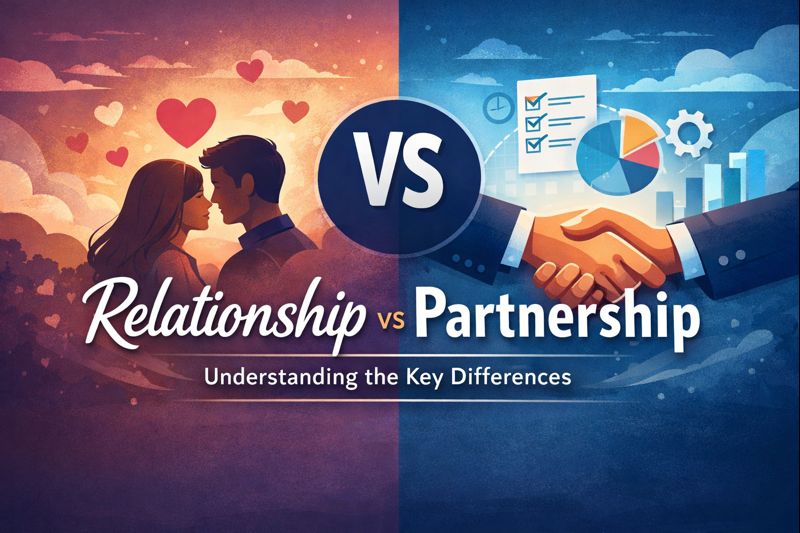

A relationship and a partnership are often treated as interchangeable concepts.
However, they represent distinct modes of interaction, responsibility, and long-term alignment.
A relationship primarily centers on emotional connection.
A partnership primarily centers on shared responsibility and coordinated action.
Understanding the difference between a relationship and a partnership is critical for evaluating long-term stability in personal, professional, and collaborative contexts.
Table of Contents
Table of Contents
What Is a Relationship?
A relationship is a connection between individuals that is primarily driven by emotional engagement and interpersonal bonding.
Relationships are commonly characterized by:
- Emotional closeness
- Mutual affection or attachment
- Shared experiences
- Personal validation
- Interpersonal communication

The primary function of a relationship is to establish and maintain emotional connection.
Relationships are common in romantic, familial, social, and early-stage professional interactions.
What Is a Partnership?
A partnership is a structured association between individuals based on shared responsibility, accountability, and long-term objectives.
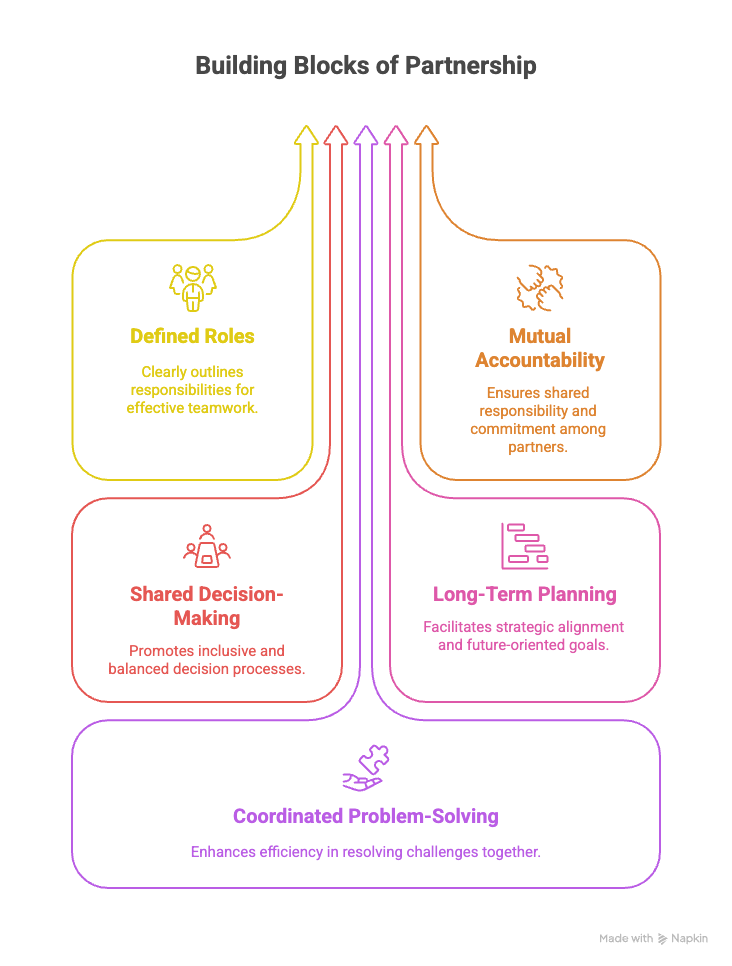
Partnerships are commonly characterized by:
- Defined roles and expectations
- Mutual accountability
- Shared decision-making
- Long-term planning
- Coordinated problem-solving
The primary function of a partnership is to enable sustained collaboration and reliable outcomes.
Partnerships are common in marriages, businesses, co-founding arrangements, and long-term collaborations.
Relationship vs Partnership: Core Differences
| Aspect | Relationship | Partnership |
|---|---|---|
| Primary driver | Emotional connection | Shared responsibility |
| Core focus | How individuals feel | How individuals function together |
| Stability source | Emotional consistency | Structural alignment |
| Conflict handling | Emotion-led responses | Resolution-led processes |
| Time orientation | Present-focused | Long-term focused |
Emotional Foundation vs Structural Foundation
Relationship Foundation
Relationships are built on emotional factors such as trust, affection, empathy, and validation.
When emotions are positive, relationships tend to feel stable.
When emotions fluctuate, relationships may experience instability.
Partnership Foundation
Partnerships are built on structural factors such as agreements, expectations, and accountability systems.
Even when emotions fluctuate, partnerships can remain stable due to established structure and shared commitments.
Short-Term Fulfillment vs Long-Term Stability
Relationships are effective at providing short-term emotional fulfillment.
Partnerships are designed to support long-term stability and continuity.
This distinction explains why emotionally strong relationships may struggle during periods of stress, while partnerships often endure under pressure.
Communication Style Differences
Relationship Communication
Communication in relationships often emphasizes emotional expression and personal validation.
Typical objectives include:
- Being understood
- Expressing feelings
- Maintaining emotional closeness
Partnership Communication
Communication in partnerships emphasizes clarity, coordination, and resolution.
Typical objectives include:
- Solving problems
- Aligning expectations
- Making joint decisions
Conflict Handling Approach
Relationship-Based Conflict
In relationship-driven interactions, conflict is often interpreted as a personal issue.
Common characteristics include:
- Emotionally reactive responses
- Focus on blame or validation
- Short-term emotional relief as the goal
Partnership-Based Conflict
In partnership-driven interactions, conflict is treated as a shared operational issue.
Common characteristics include:
- Accountability-focused discussion
- Joint problem ownership
- Resolution and prevention as the goal
Dependency vs Interdependence
Relationships may drift toward emotional dependency, where individuals rely on each other for emotional regulation or validation.
Partnerships emphasize interdependence, where individuals maintain autonomy while coordinating responsibilities and support.
Interdependence strengthens resilience and reduces long-term strain.
Reliability vs Emotional Intensity
Relationships often prioritize emotional intensity and connection.
Partnerships prioritize reliability, consistency, and follow-through.
Reliability enables trust accumulation over time, especially in long-term arrangements.
Growth Orientation
Relationships often prioritize comfort and emotional harmony.
Partnerships prioritize growth, improvement, and adaptation, even when discussions are uncomfortable.
This orientation allows partnerships to evolve alongside changing circumstances.
Love vs Commitment
Love represents an emotional state.
Commitment represents a sustained decision.
Relationships rely more heavily on emotional continuity.
Partnerships rely more heavily on commitment and responsibility.
This distinction explains why partnerships often persist through emotionally challenging periods.
Why Relationships Fail Without Partnership Structure
Relationships without partnership structure commonly fail due to:
- Undefined responsibilities
- Lack of long-term planning
- Ineffective conflict resolution
- Imbalanced accountability
- Emotional dependency
Emotional connection alone is insufficient for long-term stability.
Can a Relationship Transition Into a Partnership?
Yes.
A relationship can evolve into a partnership when participants intentionally establish shared responsibility, accountability, and long-term alignment.
This transition requires deliberate action rather than emotional momentum.
Relationship Without Partnership vs Partnership Without Relationship
A relationship without partnership often lacks stability.
A partnership without relationship often lacks emotional engagement.
Sustainable long-term bonds integrate emotional connection with structured collaboration.
Relationship vs Partnership Across Contexts
Romantic Context
- Relationship enables emotional bonding
- Partnership enables long-term stability
Marriage
- Relationship supports intimacy
- Partnership supports shared life management
Business
- Relationship builds trust and rapport
- Partnership drives execution and accountability
Friendships
- Relationship creates closeness
- Partnership creates reliability
Key Takeaways
- Relationships are emotion-driven connections.
- Partnerships are responsibility-driven collaborations.
- Relationships prioritize emotional experience.
- Partnerships prioritize long-term functionality.
- Sustainable bonds integrate both models intentionally.
Frequently Asked Questions
What is the main difference between a relationship and a partnership?
A relationship focuses on emotional connection, while a partnership focuses on shared responsibility and long-term collaboration.
Can a partnership exist without emotional connection?
Yes, partnerships can function with minimal emotional engagement, though emotional connection can improve cooperation.
Do relationships need to become partnerships to last?
Long-term stability typically requires partnership elements such as accountability and shared goals.
Are marriages relationships or partnerships?
Marriages generally function as both, combining emotional connection with shared responsibility.
Can business partnerships be emotional?
Business partnerships may include trust and respect, but they prioritize structure over emotion.
Is one better than the other?
Neither is inherently better. Their effectiveness depends on context and long-term expectations.

