
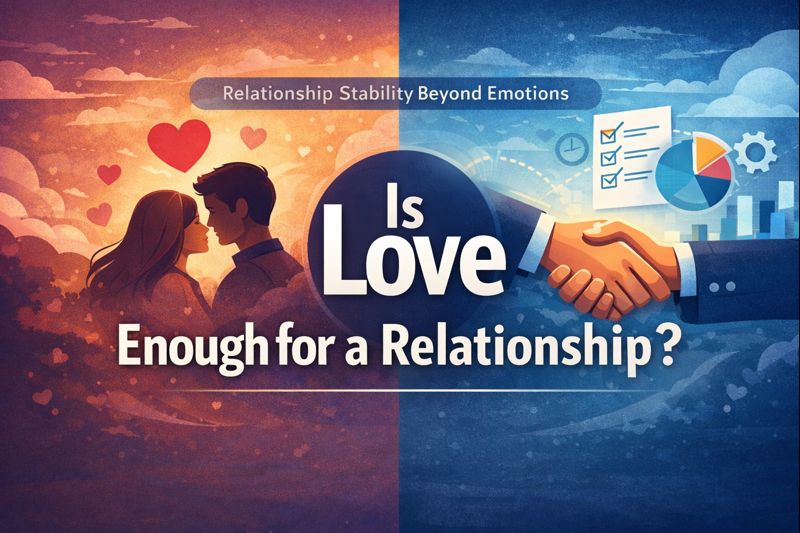

Love is an emotional connection characterized by affection, attachment, and care between individuals.
A relationship is a sustained interaction between individuals that requires emotional, behavioral, and practical alignment over time.
While love is often viewed as the foundation of a relationship, long-term stability depends on additional structural and functional elements beyond emotional connection alone.
This article explains whether love alone is sufficient for a relationship to sustain over time, and what additional factors are required for long-term relationship stability.
What Is Love?
Love is an emotional state involving attachment, affection, and emotional bonding.
Common characteristics of love include:
- Emotional closeness
- Affection and care
- Desire for connection
- Emotional attachment
- Positive emotional regard
Love primarily operates at the emotional and psychological level.
It is often the initiating force behind romantic relationships and interpersonal bonds.
What Is a Relationship?
A relationship is an ongoing interaction between individuals that includes emotional, behavioral, and functional components.
A relationship typically involves:
- Communication patterns
- Shared expectations
- Behavioral consistency
- Mutual responsibility
- Conflict management
Unlike love, a relationship functions continuously and requires ongoing coordination.
Is Love Enough for a Relationship?
Love alone is not sufficient to sustain a long-term relationship.
While love is necessary to initiate and emotionally support a relationship, it does not independently address structural, behavioral, or practical demands that arise over time.
Long-term relationships require systems that operate even when emotional intensity fluctuates.
Why Love Alone Is Insufficient
Love is inherently variable.
Relationships are continuous.
Several limitations of love-only relationships include:
- Emotional states change over time
- Love does not define responsibilities
- Love does not resolve conflict systematically
- Love does not create accountability
- Love does not ensure long-term alignment
Without additional frameworks, emotional connection alone becomes unstable under pressure.
Key Components Beyond Love
For a relationship to remain stable, several non-emotional components are required.
Communication
Clear and consistent communication enables:
- Expectation alignment
- Issue resolution
- Emotional clarity
- Behavioral coordination
Love does not automatically create effective communication.
Trust and Reliability
Trust is built through repeated, consistent behavior.
This includes:
- Keeping commitments
- Behavioral predictability
- Transparency
- Follow-through
Love may motivate trust, but trust is sustained through action.
Shared Values and Goals
Alignment on values reduces long-term friction.
Important alignment areas include:
- Life priorities
- Financial expectations
- Family planning
- Personal boundaries
Love without value alignment often leads to long-term conflict.
Conflict Resolution Mechanisms
Conflict is inevitable in any relationship.
Stable relationships rely on:
- Structured conflict resolution
- Accountability
- Repair mechanisms
- Mutual responsibility
Love does not inherently provide conflict management systems.
Responsibility and Accountability
Long-term relationships require accountability.
This includes:
- Role clarity
- Shared responsibility
- Ownership of actions
- Mutual effort
Without accountability, emotional imbalance often develops.
Love vs Relationship Stability
| Aspect | Love | Relationship Stability |
|---|---|---|
| Primary nature | Emotional | Structural and behavioral |
| Consistency | Variable | Sustained |
| Conflict handling | Emotion-driven | Process-driven |
| Accountability | Implicit | Explicit |
| Longevity support | Limited | High |
This distinction explains why emotionally strong relationships may still fail over time.
Common Misconceptions About Love and Relationships
Misconception: If love is strong, everything else works out
Reality: Love does not replace communication, planning, or accountability.
Misconception: Problems mean love is fading
Reality: Problems often indicate missing structure, not lack of love.
Misconception: Love should feel effortless forever
Reality: Long-term relationships require effort, coordination, and adaptation.
When Love Helps a Relationship
Love remains important.
It contributes to:
- Emotional bonding
- Motivation to invest
- Willingness to repair
- Empathy during conflict
Love supports a relationship, but it does not operate it.
When Love Becomes Insufficient
Love becomes insufficient when:
- Expectations are unclear
- Conflict repeats without resolution
- Responsibilities are unbalanced
- Long-term goals diverge
- Emotional dependency develops
In such cases, structural gaps, not emotional absence, are the primary issue.
Can Love Grow With Structure?
Yes.
When structure is added to love, relationships often stabilize and mature.
This includes:
- Clear communication systems
- Defined expectations
- Shared planning
- Mutual accountability
Structure does not reduce love.
It protects it.
Practical Indicators Love Is Not Enough
Indicators include:
- Repeated unresolved arguments
- Emotional burnout
- Confusion around roles
- Instability during stress
- Dependence on emotional reassurance
These signals suggest missing relational systems rather than absence of love.
Love as a Starting Point, Not a System
Love initiates connection.
Relationships require systems to continue.
Long-term stability depends on:
- Behavior consistency
- Decision alignment
- Responsibility sharing
- Growth adaptation
Love without structure often leads to instability.
Structure without love often lacks connection.
Key Takeaways
- Love is an emotional foundation, not a functional system
- Relationships require structure, accountability, and communication
- Love alone does not resolve conflict or align expectations
- Long-term stability depends on shared responsibility
- Sustainable relationships integrate love with structure
Frequently Asked Questions
Is love necessary for a relationship?
Love is not strictly necessary for all relationships, but it strengthens emotional connection and motivation.
Can a relationship survive without love?
Some relationships can function structurally without strong emotional connection, though emotional fulfillment may be limited.
Why do loving relationships fail?
Most failures result from poor communication, misaligned expectations, or lack of accountability, not lack of love.
Does love fade over time?
Emotional intensity may change, but stability depends more on behavior and structure than emotional peaks.
Is love more important than trust?
Trust is often more critical for long-term stability, while love supports emotional connection.
Can structure reduce love?
No. Structure typically protects emotional connection by reducing conflict and instability.